
The rise and fall of community capacity – making a difference in Birmingham
Media
Image
Blog content
Blog post by Abdullah Rehman
This blog is based on my experiences working as a capacity builder during my early days at the Balsall Heath Forum (BHF) and my thoughts on the current situation facing the community.
In 2008 Birmingham Strategic Partnership carried out a survey in what were the most deprived neighbourhoods in the city, and something interesting and unexpected happened. Residents answered questions such as “Do you feel you can influence decision making in your locality?” or “Do you feel safe in your neighbourhood?” To the surprise of many, the percentages for Balsall Heath came out top and showed a true sense of belonging suggesting that local residents felt they were in a stronger position than any other neighbourhood to influence change. Balsall Heath is generally considered a ‘deprived village’, with low levels of education amongst the youth, high levels of crime and an environment that looks bleak in comparison to neighbouring Edgbaston and Moseley. So the question arises WHY did we do so well in the survey?
The reputation of Balsall Heath is well known: with its history of the ‘red light’ district and open criminality that gave rise to a level of community activism never seen before anywhere in the UK. Our campaign to kill off the reputed 10 million pound vice industry that was blighting our community helped the Police in their own failing pursuit to tackle open drug dealing and prostitution on the streets of Balsall Heath. News of our success reached central Government and the press had field day. This was the first time a group of residents had organised themselves effectively as “Street Watch” volunteers. We sent out a message that actually we, the community, are not the problem, but could effectively be the solution to Birmingham’s problems across the wider city. Only now do the Council and Police see value in mobilising their biggest asset in the city, the community, but it took austerity cuts for them to realise this.
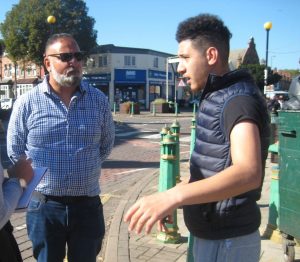
A street corner encounter – who do I turn to for advice about local problems?
So why did Balsall Heath, one of the city’s most deprived areas, come top in nearly all the questions about community life from an almost forgotten survey carried out more than a decade ago? I strongly believe it was down to people in the community feeling that after the Street Watch campaign they ‘owned’ the neighbourhood. Due to their activism and local commitment crime dropped by over 30% across the board, resulting in a rise community safety and increased pride in the neighbourhood. When you think you are part of the solution rather than part of the problem, it makes you feel that where you live is ‘Our Place’. You enter into a much bigger society where people care about the neighbourhood and ultimately about one another.
2008 was the year I progressed from being a Neighbourhood Warden to Capacity Builder. My role was to reach out to local residents and set up residents associations where people would continue to find solutions with support and encouragement of the BHF. Residents could question the Police and Councillors on how services were being delivered and this led some politicians and professionals to realise that communities were more in touch with issues than they were. Our approach was based on a collective effort to continue the Forum’s strategies for involving and empowering residents, recognising that if you have a united, majority voice, rather than an atomised or silent community, you will be listened to. This was the first sign that the Police and Councillors in particular appreciated the value of a bottom-up approach. Fifteen micro groups of residents met regularly, with decision-makers in attendance. Two of the most productive were the Kinver Croft and Seven Streets meetings with residents having their own constitution and funding to meet local needs.
But these have all now become inactive or no longer meet at all. Without a capacity builder and the support of BHF the groups are no longer viable. I believe that without someone to steer and assist the groups and to encourage the residents to participate, community members forget what they have achieved and lose interest in trying to make a difference. They fall back into a dependency on service providers, once again delivering in a top down fashion and not taking into consideration the real needs of the community they profess to serve.
Recently whilst walking round the streets of Balsall Heath as part of a shadowing session with Alison Gilchrist for the Smart Urban Intermediaries research project, I found myself in conversations to explain why BHF was no longer organising meetings for residents. People were asking me “Who do we turn to?” and “Who is our councillor now?” This made me realise how important the Forum had been and indeed my role of capacity builder. This had been crucial to our success and Forum’s model meant that many residents felt empowered, valued, active and proud of where they lived.
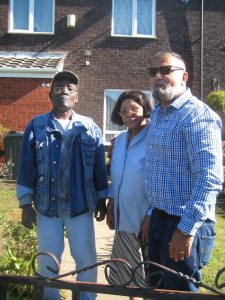
Abdullah with residents previously involved in community activities
Once more, the community are turning to BHF for solutions but with heavy heart I have to admit that with limited staff the organisation is not able to do the social work they once did. Indeed I am not part of the iconic BHF anymore, so am powerless to support. In its prime, our work was praised by so many, including Home Secretaries and Prime Ministers as the social action model for community empowerment. We also received glowing testimonials from local organisations and stakeholders, such as the elected councillors. However, some of those from agencies whose services we improved were less supportive, seeing us not as part of future solutions but a thorn in their side.
I still believe that communities will rise up again as they did in 1994 when things get so bad. They will rediscover the skills to organise themselves and strategies for collective empowerment. But for now, we watch as crime rises again and the broken windows spread across the neighbourhood. I witness the helplessness of the people who ask “Who will listen to us now?”