
Lessons-learned at the Transnational Lab in Glasgow – reflections by Han van Geel
Media
Image
Blog content
[Watch our latest video, filmed at the Transnational Lab in Govan, Glasgow]
When the plane took-off, I only had to read the last 100 pages in the recently published biography of Johan Rudolf Thorbecke. Thorbecke was a former Dutch prime-minister and an important architect of current administrative and legislative design in the Netherlands. He was also the inventor of the “playingfield”, the “game-rules” and the “game-concept” with which the creative force of Dutch society in the 19th century woke up. Thorbecke thought from “large to small”, from public to private and organized the relations between people and authorities, so that their potential was addressed. That worked, because Thorbecke’s paradigm balanced between under- and overorganisation.
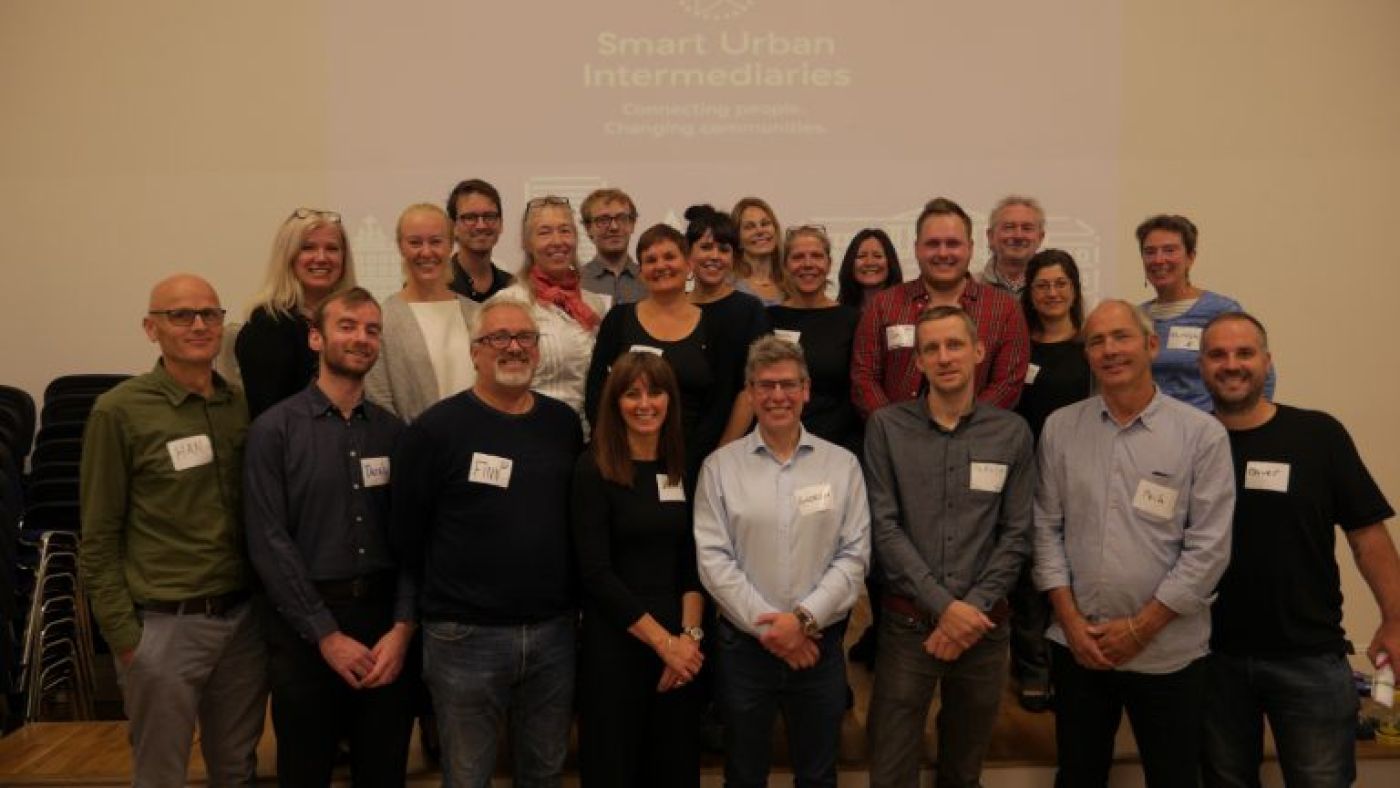
With two Dutch smart urban intermediaries (SUIs), Dorendel Overmars and Peik Suyling, I was en route to the first Transnational Lab in Glasgow. We would meet participants from Scotland, England (Birmingham) and Denmark (Copenhagen). The Transnational Lab examines how SUIs contribute to urban development. That means that the role profiles, in their respective local or national context, are studied.
Although Brexit wants us to think different, in first place, we met with fellow Europeans, raised in democratic societies with related value systems. Societies that, each in itself, also must have known their own Thorbecke’s. But of course we also didn’t escape from the differences between the Anglo-Saxon, the Rhineland and the Nordic cultures.
We met each other on Thursday morning in the restored Pearce Institute (see: http://www.pearceinstitute.org.uk/) , a multifunctional center in the district of Govan. In a first introductory pitch we exchanged experiences from which we are proud of. I met with the Scot Susan Hanlin, who, from social partnerships, develops real estate in Govan. She was (rightly!) proud of the urban renewal projects, which contributed to a new self-esteem of Govan. They relate back to Glasgow, when it was the largest shipyard in the world. The words “scale” and “risk” imprinted on me. As a District Director, in the service of a local government in the Dutch county town of Zutphen, I shared my pride on a methodical formula that, 15 years ago, supercharged the self-efficacy of a district. How can disparate contributions and results such as those of Susan and myself, be mutually appreciated and evaluated?
We went on site visits in Govan. The district showed large contrasts. It occurred to me that public spaces are very functionally designed and with little imagination. In a dilapidated store we visited a radio station with an active network of volunteers, playing an important social role in the district. A bit further, initiator Patt Cassidy introduced us into the Fairfield Heritage Centre; a spectacular restored port Office from Victorian times. Here, with Patt standing under the portrait of founder William Pearce, was the soul of Govan. Top class engineering, high-quality architecture which turned in the second half of the twentieth century to social and cultural impoverishment. But now, in 2018, the Govanites seem to find themselves back in social initiatives, making their heritage part of everyday life again.
On the walk back, we visited the Govan old Parish Church. Volunteers putting effort into giving the Church a social function again. Although old and dusty, the interior is of an aesthetic- and architectural quality, that still speaks for itself. Must planners and real estate people take the initiative. But I asked myself: would an inspiring programming be more appropriate?
A view from Anne Tortzen, Practitioner
I marveled with some Danish participants at the role of government in Scottish society. The Danish and Dutch cultures have governmental similarities. But where the Dutch, during the last economic crisis, reformed the welfare state to a participation society, the Danish have still held on. As a result, the Danes, more than the Dutch, still ask why a voluntary contribution to the quality of society is needed.
What did we learn from our meeting in Glasgow about organizing-ability? First, I learned that beliefs on organizing-ability, are culturally determined. Stronger than the Scottish and the British, the Danes and the Dutch seem to be convinced, that society is feasible and that a strong Government is needed.
The social initiatives in Glasgow are comprehensive in size and complexity. The promoters work with relatively large risks that appeal to competence, responsibility and the willingness to take risks. It is required by the circumstances in which they are active. What does this do to creative force? And what happens with the potential of citizens who are slightly less able, and willing to take risks?
The research on SUIs is driven by the expectation and the desire to enable, enlighten and empower SUIs. Thinking from large to small, I think the effectiveness of Sui’s is determined by [1] a mutually reinforcing interplay of [2] disparate roles [3] in proportion. A mutually reinforcing interplay between SUIs, in my opinion, requires the ability to value and give attention to the contribution of another SUI. This contribution may differ in scale, intensity and complexity.
Lastly, I still have to think of Anne Philbrow who, in one of the sessions with a basket of flowers in her hand, came to tell about Moogety Community Garden, her urban village gardening project; What a strength! SUIs do not come into their own when they are under- or overestimated but when you judge them on their value.
That value was present in our sessions in Glasgow and I’m looking forward to the outcome.